



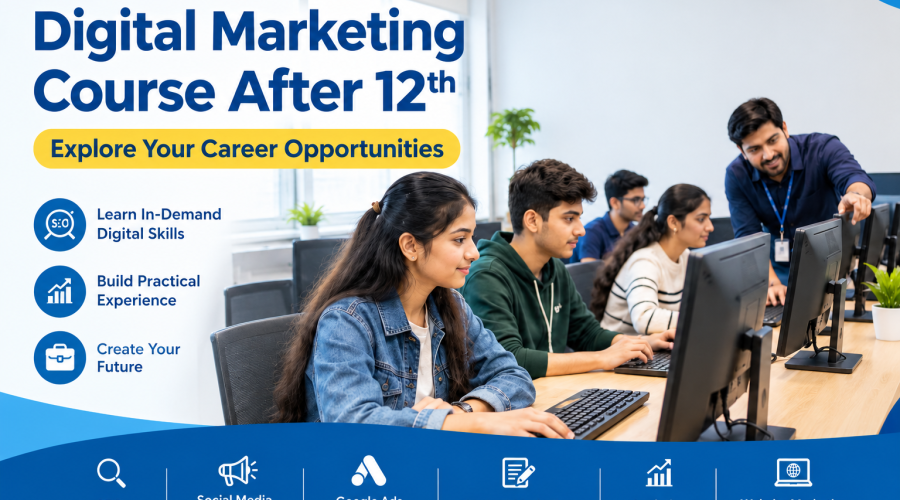
Digital Marketing Course After 12th: Is It a Good Career Choice?
Choosing the right career after completing Class 12 is an important decision for every student. Some students want to pursue a traditional degree, while others prefer learning practical skills that can help them enter the professional world. If you are interested in technology, creativity, social media or business, a digital marketing course after 12th can be a valuable career option to explore.
Digital marketing has become an important part of how businesses promote their products and services. From local shops and educational institutes to e-commerce companies and established brands, businesses use digital platforms to reach customers, generate leads and increase sales.
For students in Sirsa, Haryana, digital marketing offers an opportunity to develop practical skills without necessarily moving to a bigger city for initial training. With the right course, regular practice and a strong portfolio, students can prepare for opportunities in employment, freelancing and entrepreneurship.
In this guide, we will explain the benefits, eligibility, course syllabus, career opportunities and future scope of digital marketing, along with how to choose the right training institute.
What Is a Digital Marketing Course After 12th?
A digital marketing course after 12th teaches students how to promote businesses, products and services through online platforms. It covers different methods of reaching potential customers, creating engaging content, improving website visibility and measuring marketing performance.
Unlike traditional marketing, digital marketing allows businesses to target specific audiences and evaluate the results of their campaigns using data and analytics.
Depending on the institute and course structure, students may learn:
- Search Engine Optimisation (SEO)
- Social Media Marketing
- Google Ads and paid advertising
- Facebook and Instagram advertising through Meta Ads
- Content marketing and copywriting
- Website optimisation
- Email marketing
- Lead generation
- Digital marketing analytics
- AI tools for marketing
A well-structured digital marketing course after 12th should combine theoretical knowledge with practical assignments and real-world projects.
Students should also understand that digital marketing is a skill-based profession. Completing a course can provide a foundation, but career growth depends on how effectively students apply their knowledge, solve business problems and adapt to new tools.
Is Digital Marketing a Good Career Choice After 12th?
Yes, digital marketing can be a good career choice after Class 12 for students who enjoy learning, creativity, communication and problem-solving. However, it is important to choose the field because it matches your interests rather than expecting instant earnings.
Here are some reasons to consider this career.
1. You Can Start Learning Early
One of the advantages of a digital marketing course after 12th is that students can begin developing professional skills early in their careers.
You do not necessarily need a specialised marketing degree to begin learning the fundamentals. Many beginner-level training programmes accept students from Arts, Commerce and Science backgrounds.
You can also pursue graduation alongside practical digital marketing training. This approach allows you to continue your formal education while building skills that may help you prepare for internships and entry-level positions.
2. Opportunities Across Different Industries
Digital marketing is relevant to many types of businesses.
For example, a clothing store may use Instagram to showcase its products, a coaching institute may run Google Ads to attract admissions enquiries, and a local service provider may use SEO to appear in relevant search results.
This creates potential opportunities in:
- Digital marketing agencies
- Educational institutes
- Retail and e-commerce businesses
- Healthcare and professional services
- Hospitality and tourism
- Start-ups and established companies
- Freelance marketing services
Students completing a digital marketing course after 12th can explore these sectors according to their interests and skill levels.
3. Multiple Career Paths
Digital marketing is not limited to managing social media accounts. It includes several specialised areas, such as SEO, paid advertising, content strategy, analytics and website marketing.
Students can start with basic marketing knowledge and gradually specialise in the area they enjoy most.
4. Freelancing and Remote Work Possibilities
Digital marketing skills can be used to work with clients outside your immediate location.
For example, a freelancer based in Sirsa may help a business in Delhi, Chandigarh or another city manage social media, optimise website content or run advertising campaigns.
However, freelancing requires more than technical knowledge. Students must also learn client communication, project management, pricing and professional reporting.
5. Useful Skills for Starting a Business
If you plan to start a business in the future, digital marketing can help you understand how to promote your products and services online.
You can learn how to reach potential customers, create marketing content, build an online presence and measure campaign performance.
These skills can be useful even if you eventually choose a career outside a traditional digital marketing job.
Who Can Join a Digital Marketing Course After 12th?
A digital marketing course after 12th can suit students from different educational backgrounds. Your stream does not necessarily determine whether you can learn digital marketing.
Arts students: Students interested in writing, communication, design and media may enjoy content marketing, social media management and SEO.
Commerce students: Students interested in business, sales, consumer behaviour and entrepreneurship may explore advertising, lead generation and marketing analytics.
Science students: Students who enjoy technology, data and analytical thinking may find opportunities in performance marketing, analytics and marketing automation.
Students interested in creative work: If you enjoy designing posts, making videos or creating online content, you can combine digital marketing with graphic design and video editing.
Most importantly, you should be comfortable using computers or willing to learn. Good communication, curiosity, consistency and a willingness to practise are valuable qualities for beginners.
Before enrolling in a digital marketing course after 12th, check the institute's eligibility requirements, course duration and practical training structure.
What Is Taught in a Digital Marketing Course After 12th?
The syllabus varies between institutes, so students should compare the modules before selecting a programme. A practical course may include the following subjects.
1. Search Engine Optimisation (SEO)
SEO involves improving a website's visibility in organic search results.
Students learn keyword research, on-page SEO, technical SEO fundamentals, internal linking, content optimisation and link-building principles.
Local SEO is particularly useful for businesses serving specific areas. For example, a business may want to appear when someone searches for a relevant service in Sirsa.
Students should learn how to create useful content for people rather than simply repeating keywords.
2. Social Media Marketing
Social media marketing involves planning and publishing content across platforms such as Instagram, Facebook and LinkedIn.
Students may learn content calendars, audience research, post planning, engagement strategies, campaign objectives and performance measurement.
They should also understand how to maintain a consistent brand identity and create content that matches the needs of a particular audience.
3. Google Ads and Meta Ads
Paid advertising helps businesses reach potential customers through targeted campaigns.
Students can learn campaign planning, audience selection, ad copywriting, budget management, conversion tracking and performance optimisation.
Practical training is especially important in this area because students need to understand how advertising decisions affect campaign results.
4. Content Marketing and Copywriting
Content marketing involves creating useful and relevant information to attract and engage an audience.
This may include blog articles, website content, social media captions, email campaigns and promotional messages.
Copywriting focuses on communicating a clear message that encourages the reader to take a relevant action.
5. Website Marketing and Analytics
Students should understand the role of websites in digital marketing, including landing pages, user experience, calls to action and website content.
Analytics helps marketers understand how visitors interact with websites and campaigns.
Students can learn to evaluate traffic, engagement, leads and conversions so that marketing decisions are based on evidence rather than guesswork.
6. AI Tools for Digital Marketing
AI tools can support content planning, research, brainstorming, reporting and creative production.
However, students should learn to check AI-generated information, maintain originality and ensure that content is accurate and useful.
A digital marketing course after 12th that includes relevant tools and practical exercises can help students develop a stronger understanding of modern marketing workflows.
Career Opportunities After a Digital Marketing Course After 12th
After developing the required skills, students can explore different entry-level roles. The exact opportunities available depend on their practical ability, communication skills, experience and the requirements of employers.
Some potential career paths include:
Digital Marketing Executive: Assists with marketing campaigns, website promotion, social media activities and performance reports.
SEO Executive: Works on keyword research, website optimisation, content improvements and search visibility.
Social Media Executive: Plans content, schedules posts, engages with audiences and monitors account performance.
Content Writer: Creates blog posts, website pages, captions and other marketing content.
Performance Marketing Executive: Helps manage paid advertising campaigns and analyse their results.
Email Marketing Executive: Supports email campaigns, audience segmentation and campaign reporting.
Freelance Digital Marketer: Provides selected digital marketing services to individual clients and businesses.
Entrepreneur: Uses digital marketing knowledge to promote a personal brand, online store or local business.
Students do not need to master every specialisation immediately. It is often more effective to understand the fundamentals first and then develop deeper expertise in one or two areas.
What Salary Can You Expect After Learning Digital Marketing?
Salary depends on the employer, job role, location, practical skills and experience. There is no fixed salary guaranteed after completing a digital marketing course after 12th.
Entry-level candidates may find opportunities as trainees, interns or junior executives. Their initial compensation can vary considerably between small local businesses, agencies and larger organisations.
As a general planning guide, students may research entry-level opportunities in the following indicative ranges:
| Experience level | Indicative monthly salary |
|---|---|
| Internship or trainee | ₹5,000–₹12,000 |
| Entry-level executive | ₹10,000–₹20,000 |
| Experienced professional | ₹20,000–₹40,000+ |
| Specialist or senior professional | ₹40,000+ |
These are illustrative estimates, not verified salary averages or guaranteed earnings. Actual offers may fall below or above these ranges.
Professionals who demonstrate strong campaign performance, analytical ability, client management and specialised expertise may improve their earning potential over time.
Freelancing income is different from a fixed salary. It depends on the number of clients, project fees, workload and the ability to retain customers.
Instead of selecting a course based only on advertised salary claims, focus on building skills that employers and clients can evaluate through practical work.
Why Practical Training Matters More Than Just a Certificate
A certificate can demonstrate that you completed a training programme, but it cannot independently prove that you can manage a marketing campaign.
That is why practical learning should be an important factor when selecting a digital marketing course after 12th.
Look for a course that includes:
- Hands-on assignments and exercises
- Keyword research and SEO projects
- Social media content planning
- Ad campaign planning and optimisation
- Website and content audits
- Analytics and performance reporting
- Portfolio development
- Interview preparation and career guidance
Students should try to build a portfolio containing examples of their work, such as an SEO audit, a sample content calendar, an advertising plan or a marketing report.
Real client projects can also provide valuable experience when they are supervised appropriately and use authorised access to business accounts.
A portfolio gives employers a clearer picture of your practical abilities and helps you discuss your work confidently during interviews.
How to Choose the Right Digital Marketing Institute in Sirsa
If you live in Sirsa or nearby areas of Haryana, you can compare local training options before making a decision. Consider these factors when choosing an institute.
1. Updated course syllabus: Check whether the curriculum covers relevant marketing channels, analytics and current tools.
2. Practical classroom training: Ask how much time is devoted to assignments, projects and hands-on exercises.
3. Mentor support: Look for instructors who can explain concepts clearly and help you solve practical problems.
4. Portfolio development: Confirm whether you will complete projects that demonstrate your skills.
5. Career assistance: Ask about internships, CV preparation, interview guidance and job assistance. Clarify exactly what support is included.
6. Transparent fees and duration: Understand the total course fee, payment terms, training duration and any additional costs.
7. Student work and reviews: Where possible, review genuine student projects and speak to previous learners.
A good institute should explain what you will learn, how you will practise and what career preparation it offers without guaranteeing unrealistic results.
Learn Digital Marketing at Internet Space Academy, Sirsa
For students looking for practical digital skills training locally, Internet Space Academy offers digital marketing training in Sirsa, Haryana.
The academy focuses on offline classroom learning, practical assignments, mentor guidance and real-world projects. Its digital marketing curriculum includes areas such as SEO, Google Ads, Meta Ads, social media marketing, content marketing, lead generation and analytics.
Students can also explore related skills such as graphic design, website designing and video editing to understand how different digital channels work together.
For example, a marketing campaign may require an SEO-friendly landing page, engaging social media creatives, well-written ad copy and a system for tracking enquiries. Learning these connected skills can help students understand how digital marketing works in practice.
Internet Space Academy also highlights career guidance, internship opportunities and job assistance. Students should contact the academy directly to confirm the current course structure, fees, available batches and the specific career support included.
You can learn more about the available programmes here:
Digital Marketing Courses in Sirsa: https://internetspaceacademy.com/digital-marketing-courses-in-sirsa/
Official Website: https://internetspaceacademy.com/
If you are considering a digital marketing course after 12th, compare the curriculum with your career goals and ask how much practical experience you will gain before enrolling.
Should You Pursue Graduation Alongside Digital Marketing?
For many students, combining graduation with practical digital marketing training can be a sensible option.
A degree may provide broader academic knowledge and help meet the eligibility requirements for certain jobs or future educational opportunities. Digital marketing training can complement that education by developing practical, industry-related skills.
For example, a student pursuing a Bachelor of Commerce may learn business and accounting fundamentals while developing skills in online advertising and lead generation.
Similarly, a student studying journalism or mass communication may combine academic learning with SEO, content writing, social media management and digital publishing.
Your decision should depend on your long-term goals, finances, interests and preferred career path. A short-term skills course and a formal degree serve different purposes, so consider how each fits into your plans.
Tips to Build a Successful Digital Marketing Career
Completing a course is only the beginning. To improve your chances of building a career, follow a consistent learning process.
Practise regularly: Apply your learning through small projects rather than relying only on classroom notes.
Build your portfolio: Keep examples of your writing, SEO research, campaign plans, designs and reports.
Stay updated: Digital platforms change frequently, so continue learning from reliable documentation and industry resources.
Improve communication: Learn to explain marketing decisions clearly to clients, colleagues and managers.
Understand data: Develop the ability to interpret results, identify problems and recommend improvements.
Gain experience: Explore suitable internships, supervised projects or entry-level opportunities.
Develop a specialisation: Once you understand the basics, consider focusing on SEO, paid advertising, social media or another area that matches your strengths.
These habits can help you turn the knowledge gained through a digital marketing course after 12th into practical professional capability.
Conclusion
A digital marketing course after 12th can be a worthwhile career choice for students who want to develop practical skills in online promotion, content creation, advertising and business growth.
It offers several possible career directions, including SEO, social media management, paid advertising, content marketing, freelancing and entrepreneurship. Students can also pursue graduation alongside their training to maintain broader academic and career options.
However, success does not depend on a certificate alone. Practical experience, consistent learning, communication skills and a portfolio of completed projects are equally important.
For students in Sirsa, Haryana, Internet Space Academy provides an opportunity to explore offline digital skills training with a focus on practical projects and career preparation.
Before enrolling, review the course syllabus, ask about hands-on training and clarify the career support available. Choose a programme that matches your interests and gives you opportunities to practise what you learn.
Ready to explore digital marketing as a career? Visit Internet Space Academy to explore digital marketing training in Sirsa and take the next step towards developing your professional skills.