
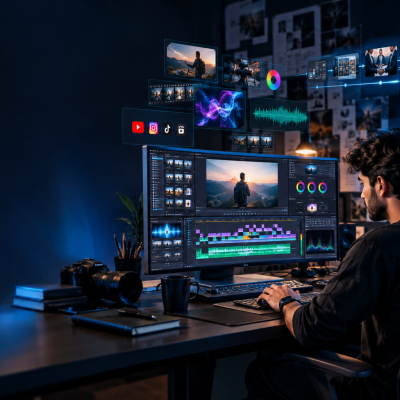


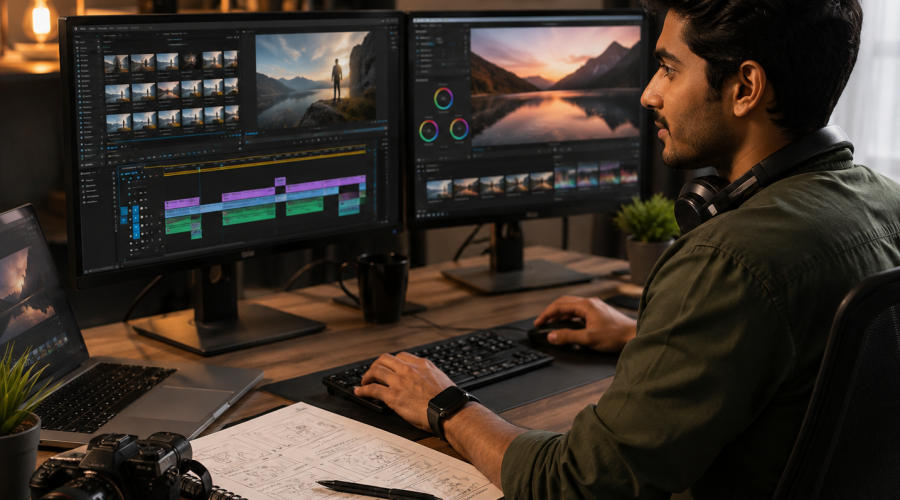
Video Editing in Sirsa is becoming an increasingly valuable skill for students, aspiring creators, freelancers and business owners who want to create professional content for today's digital world.
From Instagram Reels and YouTube Shorts to promotional videos, vlogs, advertisements and brand campaigns, video has become one of the most powerful ways to communicate online.
The good news is that you do not need to move to a metro city to start learning this skill. With the right practical training, software knowledge, creative guidance and portfolio-building experience, students can begin developing professional editing skills locally.
Internet Space Academy in Sirsa offers practical digital skills training designed to help learners understand not just how editing software works, but also how videos are planned, edited, optimised and used in real projects.
Why Is Video Editing Becoming an Important Career Skill?
Video Editing in Sirsa is no longer limited to film studios or professional production houses. Today, almost every business and creator needs video content.
A local clothing store may need Instagram Reels. A real estate company may need property walkthrough videos. A restaurant may need promotional content. A YouTuber needs long-form and short-form video editing.
Even students can use video editing to build a personal brand or begin freelancing.
Video content is now used across:
- Instagram Reels
- YouTube videos
- YouTube Shorts
- Facebook videos
- Business advertisements
- Product promotions
- Educational content
- Podcasts
- Wedding and event videos
- Vlogs
- Corporate presentations
- Online courses
This creates opportunities for people who can combine technical editing skills with creativity and storytelling.
However, learning to press buttons inside an editing application is not enough. A good editor understands pacing, visual storytelling, sound, transitions, audience attention and platform requirements.
That is why practical training can make a significant difference.
What Do You Learn in a Video Editing Course?
A well-structured video editing course should take a beginner from the fundamentals to practical project creation.
The exact learning journey can vary, but important areas generally include the following.
Understanding Video Editing Fundamentals
Before working with advanced effects, students need to understand how video editing actually works.
This includes:
- Importing and organising footage
- Understanding timelines
- Cutting and trimming clips
- Joining multiple clips
- Understanding video formats
- Working with resolutions
- Learning aspect ratios
- Managing project files
These fundamentals create the foundation for more advanced editing.
Storytelling Through Video
A professional video is not simply a collection of clips.
Good editing helps create a story.
Students should learn how to arrange footage so that viewers understand the message and remain interested. This can involve selecting the right shots, controlling pacing and creating a clear beginning, middle and end.
For social media, storytelling becomes even more important because the first few seconds can determine whether a viewer continues watching.
Transitions, Text and Visual Effects
Modern content frequently uses visual elements to make videos more engaging.
Depending on the project, students may work with:
- Basic transitions
- Text overlays
- Animated text
- Speed adjustments
- Filters
- Visual effects
- Keyframes
- Motion-based elements
- Picture-in-picture effects
The goal should not be to add effects everywhere. Instead, students should understand when an effect improves the message and when a simpler edit is more effective.
Video Editing in Sirsa for Beginners: Can You Start Without Experience?
Absolutely.
One of the biggest misconceptions about Video Editing in Sirsa is that a student must already understand cameras, professional software or filmmaking.
Beginners can start by learning the basic workflow.
A step-by-step learning process may look like this:
- Understand the editing interface.
- Import video and audio files.
- Learn cutting and trimming.
- Arrange clips on the timeline.
- Add music and sound effects.
- Use text and transitions.
- Understand colour and visual adjustments.
- Create complete projects.
- Export videos for different platforms.
- Build a portfolio.
The most important requirement is consistent practice.
A beginner who regularly edits different types of projects can improve much faster than someone who only watches tutorials.
Who Can Learn Video Editing?
Video editing is a flexible skill because it can be useful for many different people.
Students
Students can learn video editing while studying and potentially use the skill for internships, freelance work or future creative careers.
Aspiring Content Creators
YouTubers, Instagram creators and personal brands can learn to edit their own videos and develop a recognisable content style.
Freelancers
A skilled video editor can provide editing services to businesses, agencies, creators and online clients.
Business Owners
Business owners can understand how to create promotional videos, product content and social-media campaigns.
Graphic Designers and Digital Marketers
Video editing can complement other digital skills.
For example, a graphic designer can learn motion-based content, while a digital marketer can better understand how to create advertisements and social-media videos.
Why Offline Video Editing Classes Can Be Helpful
Online tutorials are useful, but they can sometimes create a fragmented learning experience.
A student may watch one tutorial about transitions, another about colour grading and another about freelancing without understanding how everything fits together.
Practical offline learning can offer a more structured approach.
Students may benefit from:
- Direct interaction with mentors
- Immediate doubt-solving
- Practical exercises
- Feedback on projects
- A structured learning path
- Guidance on improving mistakes
- Exposure to different types of projects
For someone searching for Video Editing in Sirsa, local practical training can also make it easier to stay consistent and receive personal guidance while learning.
Video Editing for Instagram, YouTube and Social Media
Social media has created a major demand for short-form video.
Businesses want Reels.
Creators want engaging Shorts.
Brands want advertisements that capture attention quickly.
This means editors need to understand more than traditional video editing. They should also understand platform-specific requirements.
Instagram Reels
Reels often require:
- Vertical 9:16 formatting
- Strong opening hooks
- Fast-paced editing
- Captions or text overlays
- Attention-grabbing visuals
- Suitable audio
- Clear calls to action
YouTube Shorts
Short-form YouTube content often focuses on delivering information or entertainment quickly.
An editor may need to remove unnecessary pauses, improve pacing and ensure that the message remains clear.
Long-Form YouTube Videos
Longer videos require a different approach.
Editors may need to organise multiple sections, add B-roll, improve audio, include graphics and maintain audience engagement over a longer duration.
Learning these differences is an important part of becoming a versatile editor.
What Video Editing Software Can You Learn?
The best software depends on the type of work you want to create.
The existing Video Editing curriculum at Internet Space Academy includes training around mobile-friendly and creator-focused tools such as CapCut and VN, along with editing concepts such as keyframes, audio syncing, colour grading and social-media video creation.
CapCut
CapCut is widely used for creating short-form content.
Students can learn concepts such as:
- Cutting and trimming
- Multi-layer editing
- Text overlays
- Transitions
- Speed control
- Audio synchronisation
- Visual effects
It can be useful for creating Reels, Shorts and other fast-paced content.
VN Video Editor
VN can help learners understand additional editing workflows and creative features.
Students may work with:
- Filters
- Audio adjustments
- Keyframes
- Speed changes
- Time-lapse effects
- Colour adjustments
The Importance of Learning Concepts, Not Just Software
Software changes. Features change. New AI-powered editing tools continue to appear.
However, fundamental editing concepts remain valuable.
If you understand storytelling, timing, pacing, sound and visual communication, adapting to new software becomes much easier.
Advanced Skills That Can Improve Your Editing
Once the basics become comfortable, students can explore more advanced techniques.
Colour Grading
Colour can influence how a video feels.
A warm colour treatment can create a different mood from a darker cinematic style.
Students should learn the difference between basic colour correction and creative colour grading.
Audio Editing
Poor audio can reduce the quality of an otherwise good video.
Useful skills include:
- Adjusting volume
- Synchronising audio
- Reducing unwanted sound
- Adding background music
- Balancing voice and music
- Using sound effects effectively
Green Screen and Chroma Key
Green screen editing can allow editors to replace or manipulate backgrounds.
This technique can be useful for educational content, advertisements and creative projects.
Motion Graphics and Animation
Simple animated elements can make information easier to understand.
For example, animated text, arrows and visual callouts can help highlight important information in social-media or educational videos.
Career Opportunities After Learning Video Editing
One reason Video Editing in Sirsa is attracting students is the variety of career paths available after developing strong skills.
Possible opportunities include:
- Freelance video editor
- Social media video editor
- YouTube editor
- Reels editor
- Content creator
- Digital marketing executive
- Creative agency team member
- Video production assistant
- Brand content editor
- Wedding and event video editor
Some professionals also combine video editing with other skills.
For example, a person may offer:
- Graphic design + video editing
- Social media management + video editing
- Digital marketing + video content
- Photography + video editing
This combination can make a portfolio more versatile.
Can You Earn Through Freelance Video Editing?
Yes, but learning software alone does not guarantee income.
Successful freelancers also need to understand how to:
- Build a portfolio
- Communicate with clients
- Understand project requirements
- Manage revisions
- Deliver files professionally
- Set appropriate pricing
- Find potential clients
The existing Internet Space Academy Video Editing curriculum specifically includes portfolio building, freelancing concepts, client expectations and managing revisions.
A practical learning approach should therefore focus on both technical and professional skills.
How to Build a Strong Video Editing Portfolio
A portfolio helps potential clients or employers see what you can actually do.
Instead of uploading random projects, create examples that demonstrate different editing abilities.
A beginner portfolio could include:
- An Instagram Reel
- A YouTube Short
- A promotional business video
- A talking-head edit
- A vlog
- A cinematic montage
- A product advertisement
- A before-and-after editing example
Try to show variety.
A client looking for short-form social-media content may not be interested in a wedding video. Similarly, a YouTuber may want to see how you handle longer content.
Your portfolio should match the type of clients you want to attract.
How to Choose the Right Video Editing Course in Sirsa
Before joining any course, ask practical questions.
1. Is the Training Practical?
Find out whether students actually create projects or mainly learn through theory.
Practical assignments are important because editing is a skill that improves through repetition.
2. Does the Course Cover Current Content Formats?
The course should consider modern formats such as:
- Instagram Reels
- YouTube Shorts
- Promotional videos
- Creator content
- Brand videos
3. Is There Personal Guidance?
Beginners often get stuck on small technical or creative problems.
Access to mentors and doubt-solving can make the learning process easier.
4. Does the Course Help Build a Portfolio?
A course should ideally help students finish projects they can later show to potential clients or employers.
5. Are Freelancing and Career Topics Included?
Technical skills are essential, but students can also benefit from learning how to present their work and communicate professionally.
6. Is the Learning Environment Suitable?
For students who prefer face-to-face learning, an offline classroom can provide more structure and accountability.
These factors are important when comparing options for Video Editing in Sirsa.
Why Consider Internet Space Academy for Video Editing Training?
Internet Space Academy positions itself as a practical offline digital skills academy in Sirsa.
Its website highlights several features designed to support students during the learning process.
Practical Learning Approach
The academy emphasises learning through practical work and projects rather than relying only on theoretical instruction.
The Video Editing curriculum covers everything from basic editing concepts and software workflows to storytelling, colour grading, advanced techniques and freelancing.
1-to-1 Guidance and Mentorship
Personal guidance can be particularly valuable for beginners who need help understanding tools or improving creative decisions.
Live Project Exposure
Working on practical assignments can help students understand how editing is used in real digital marketing, business and content creation.
Multiple Digital Skills Under One Roof
Students interested in broader creative careers can also explore related areas such as Graphic Design, Digital Marketing, Social Media Management, Website Development and AI tools.
This can be useful for learners who want to build a broader digital portfolio.
Support for Students From Outside Sirsa
The website also mentions hostel facilities near the academy for students travelling from other areas.
This may be useful for learners coming from nearby towns and regions.
What Makes a Good Video Editor?
Professional editing is a combination of technical knowledge and creative thinking.
A good editor generally develops:
- Attention to detail
- Storytelling ability
- Creativity
- Patience
- Time management
- Understanding of audience behaviour
- Knowledge of social-media trends
- Communication skills
The best way to improve is to edit regularly.
Try recreating different video styles. Analyse videos that perform well. Observe where creators use cuts, text, music and visual changes.
Then experiment with your own projects.
The Future of Video Editing
Video editing will continue to evolve as platforms and technology change.
AI tools may make certain tasks faster, such as:
- Automatic captions
- Background removal
- Silence removal
- Basic clip generation
- Audio cleanup
- Object tracking
However, AI does not eliminate the need for creative decision-making.
Someone still needs to understand the audience, select the best moments, structure the story and create a final video that communicates effectively.
This is why learning the fundamentals remains important.
Students who understand both editing principles and modern tools will be better positioned to adapt as technology evolves.
Start Your Video Editing Journey in Sirsa
If you are interested in Video Editing in Sirsa, the most important step is to start creating.
Do not wait until you know every tool or own expensive equipment.
Begin by understanding the fundamentals, practise consistently and create projects that can become part of your portfolio.
Internet Space Academy offers practical digital skills training for students who want to explore creative and career-focused skills in an offline learning environment.
You can explore the academy's existing Video Editing curriculum to understand the topics covered, including CapCut and VN training, storytelling, social-media content, colour grading, advanced editing techniques, portfolio development and freelancing concepts.
For students who want to combine editing with other high-value digital skills, Internet Space Academy also offers learning opportunities in Graphic Design, Digital Marketing and Social Media Management.
Conclusion
Learning Video Editing in Sirsa can open opportunities for students, freelancers, content creators and professionals who want to work in the growing digital content industry.
The key is to focus on more than just software.
Learn how to tell stories. Understand pacing. Improve audio. Create content for different platforms. Build a portfolio and continue practising.
With practical training and consistent project work, video editing can become a valuable skill that supports creative careers, freelance opportunities and modern digital marketing work.